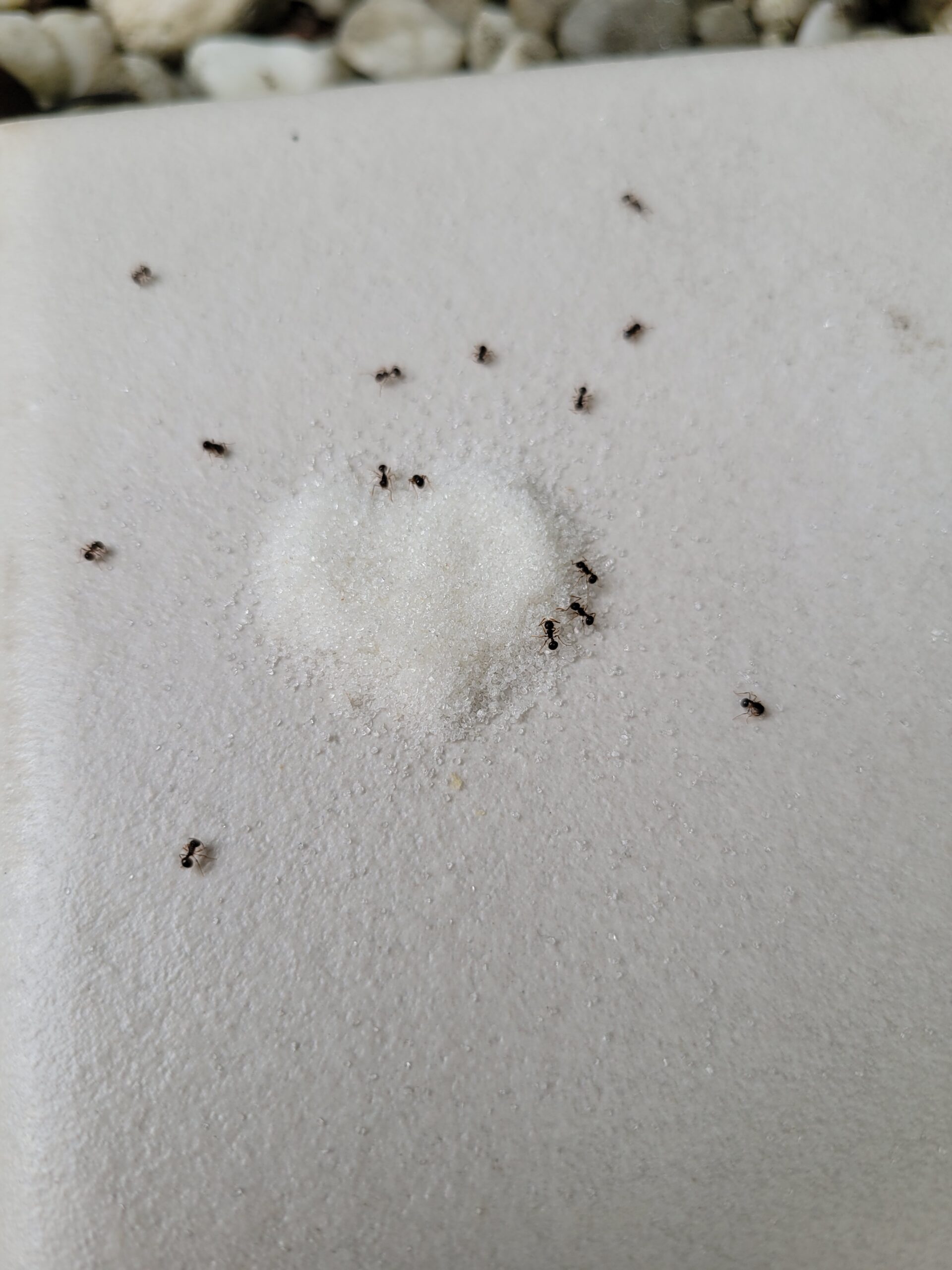
 ほっし校長
ほっし校長 お庭に置いたグラニュー糖に蟻があまり寄ってこないという現象には、いくつかの科学的かつ生態学的な理由が考えられます。蟻の習性に基づき、その要因を解説します。
### 1. 蟻の好みや目的の不一致
蟻は常に砂糖だけを求めているわけではありません。
* **食性の多様性:** 多くの蟻は雑食性です。コロニー(巣)の状況によっては、砂糖のような炭水化物よりも、幼虫の成長に必要なタンパク質(他の小さな虫の死骸など)を優先的に探している時期があります。
* **フェロモンの未伝達:** 蟻は「餌を見つける」と、巣までの帰路にフェロモン(道しるべ)を出し、仲間を呼び寄せます。最初の数匹がその砂糖を「価値がある」と判断し、フェロモンを出し始めるまでには時間がかかります。もし砂糖を見つけた最初の数匹が、その「量」や「質」を巣にとって重要ではないと判断すれば、本格的な動員はかかりません。
### 2. 環境要因と警戒心
* **警戒行動:** 蟻は非常に警戒心が強い生き物です。突然置かれた大量の物質に対して、いきなり群がるのではなく、まずは偵察兵が近づいて安全を確認し、その後、他の仲間を呼ぶというプロセスを経ます。設置から1時間半という時間は、人間には長く感じますが、蟻の社会においては「偵察・評価・帰還」のサイクルとしてはまだ初期段階である可能性があります。
* **外敵や環境の変化:** 設置した場所の周辺に、蟻にとって危険な捕食者がいたり、風や気温の変化によって餌の質が「今は適さない」と判断されたりすると、通り過ぎる行動をとることがあります。
### 3. 砂糖の種類と性質
* **乾燥と物理的障壁:** グラニュー糖は粒子が細かく、蟻にとっては非常に運びやすいものですが、野外では急速に湿気を吸ったり、風で飛んだりすることがあります。もし砂糖が乾燥しすぎていたり、逆に湿って固まっていたりすると、蟻の口器や運び方に適さず、魅力が低下することがあります。
### 4. 蟻の種類による違い
* **特定の嗜好性:** お庭にいる蟻の種類が、甘いものよりも脂質やタンパク質を好む種類である場合、純粋な炭水化物であるグラニュー糖に対する反応は鈍くなります。また、特定の種類の蟻は、他の餌源(近くの樹液やアブラムシの分泌物など)にすでに安定した道筋(フェロモンルート)を作っている場合、新しい餌へ切り替えることは稀です。
### 結論として
現時点で蟻が無視しているように見えるのは、**「その砂糖が、今の巣にとって最優先の資源ではない」**か、あるいは**「巣への伝達プロセスがまだ完了していない(偵察段階である)」**という可能性が高いです。
もし、さらに時間が経過しても寄ってこないようであれば、その場所の蟻たちはより魅力的、あるいは安定した別の餌場をすでに確保していると考えられます。
◻️英語に翻訳いたしました。
Here is a formal, scientific translation written in the style of a research commentary or ecological analysis.
***
### Foraging Dynamics: Why Granulated Sugar May Fail to Elicit Recruitment in Formicidae
The failure of a significant quantity of sucrose (granulated sugar) to initiate mass recruitment in local ant populations, despite the species being notoriously opportunistic foragers, can be attributed to several behavioral and ecological factors intrinsic to *Formicidae* colony dynamics.
**1. Variability in Nutritional Requirements**
Ant colonies operate under fluctuating metabolic demands. Depending on the colony’s current developmental stage, workers may prioritize protein-rich resources for larval rearing over carbohydrate-heavy substrates. If the colony’s nutritional status is currently skewed toward protein, the workers will exhibit selective foraging behavior, actively ignoring carbohydrate sources—even high-value ones like refined sugar—in favor of prey or other nitrogenous inputs.
**2. Thresholds for Recruitment and Information Transfer**
Ant foraging is mediated by trail pheromones, which serve as positive feedback loops for resource exploitation. Recruitment is not instantaneous; it requires an initial “scout” to evaluate the quality and quantity of the resource. If the scouts determine the resource is transient, or if the initial sample size is insufficient to trigger the threshold required for mass recruitment, the pheromone signal will not be reinforced, and the colony will maintain its current foraging trajectory.
**3. Environmental and Contextual Constraints**
* **Foraging Fidelity:** Ants often exhibit high site fidelity to established, stable food sources (e.g., aphid honeydew or existing vegetation). Once a colony has established a reliable trail network, they are less likely to deviate toward novel, unverified food sources unless those sources offer a clear caloric advantage or the current source is exhausted.
* **Neophobia:** Many ant species display neophobia, a cautious response to novel stimuli in their environment. A large, sudden introduction of material can trigger defensive or exploratory behaviors rather than immediate collection.
**4. Species-Specific Diet Specialization**
The efficacy of sucrose as a bait is highly dependent on the specific taxonomic identity of the local ant population. Some species are specialized predators or scavengers that show little interest in pure carbohydrates. Without chemical cues (such as proteins or lipids) to signify a more complex nutritional profile, generalist or specialized species may simply bypass the substrate as ecologically irrelevant.
**Conclusion**
The observed lack of recruitment suggests that the granulated sugar does not currently align with the colony’s nutritional priorities, or that the scout-to-worker feedback loop has not been activated due to existing foraging commitments or ecological caution. In short, the resource is likely being perceived as non-essential within the current spatial and temporal context of the colony’s foraging activity.
【絵本】マンタに乗った少年
★★★★★★★★★★★★★★★★★★★★★
出版社 文芸社
著者 ほっし校長
◻️2026年8月~三省堂書店本店名古屋駅ゲートタワーモール8階
◻️2026年9月~三省堂書店本店池袋駅東武百貨店地下一階
◻️2026年9月~三省堂書店神保町本店
各書店にて、絵本フェア特別コーナーでの発売中です。
また、全国の紀伊国屋書店
文教堂書店、どちらの書店においてもご購入できます。
★★★★★★★★★★★★★★★★★★★★★
【絵本】マンタに乗った少年
★★★★★★★★★★★★★★★★★★★★★
出版社 文芸社
著者 ほっし校長
2025年11月~全国書店にて発売中です。
全国の
紀伊国屋書店
文教堂書店
など
★★★★★★★★★★★★★★★★★★★★★
【絵本】マンタに乗った少年の原作は、
「【生き抜く力】ガンと闘う10歳の僕におきた奇跡」です。
こちらの書籍版はこちらから
☆☆☆☆☆☆☆☆☆☆☆☆☆☆☆☆☆☆☆☆☆☆☆☆
生き抜く力【ガンと闘う10歳の僕に起きた奇跡】|ほっし校長|note
жжжжжжжжжжжжжжжжжжжжжжжжжжжжжжжжжжжж


